

Why bother investing in the public markets?
There is a long-standing ‘conventional wisdom’ that an investment portfolio should have a significant tilt towards public equities. The “60/40” portfolio held that you should have 60% of your portfolio in public equities, and 40% in bonds (and cash-like instruments). Warren Buffet used to say “90/10”, and the “110 Rule” would have you slowly reduce your equity exposure with age… but does that still make sense?
The stock market isn’t what it used to be. 30 years ago, there were over 8,000 companies that were listed on US stock markets - today, there are less than 4,000 public companies.
The growth in venture capital, private equity and private credit over the last three decades has seen companies be able to remain private for longer, and also seen more public companies get taken private.
As someone who has personally built a business from start-up through to IPO, I am very aware of how being a listed company comes with all sorts of constraints that can stifle the entrepreneurial spirit of a business.
In addition to this, the market overall has become extremely concentrated towards a small handful of stocks. The ‘Mag-7’ tech darlings make up about 35% of the total market capitalization of the S&P 500.
With a decline in listed companies, and an extreme concentration of value in a small number of companies, the diversification available in public equities is increasingly fragile. In addition to this, it will also likely be increasingly volatile.
On top of this, the outlook for your return from public equities seems to look relatively bleak. Goldman Sachs recently stated that their base case was that the S&P would provide an annualized return of around 6.5% per annum over the next 10 years; and Charles Schwab had a similar 10 outlook of around 5.9% per annum.
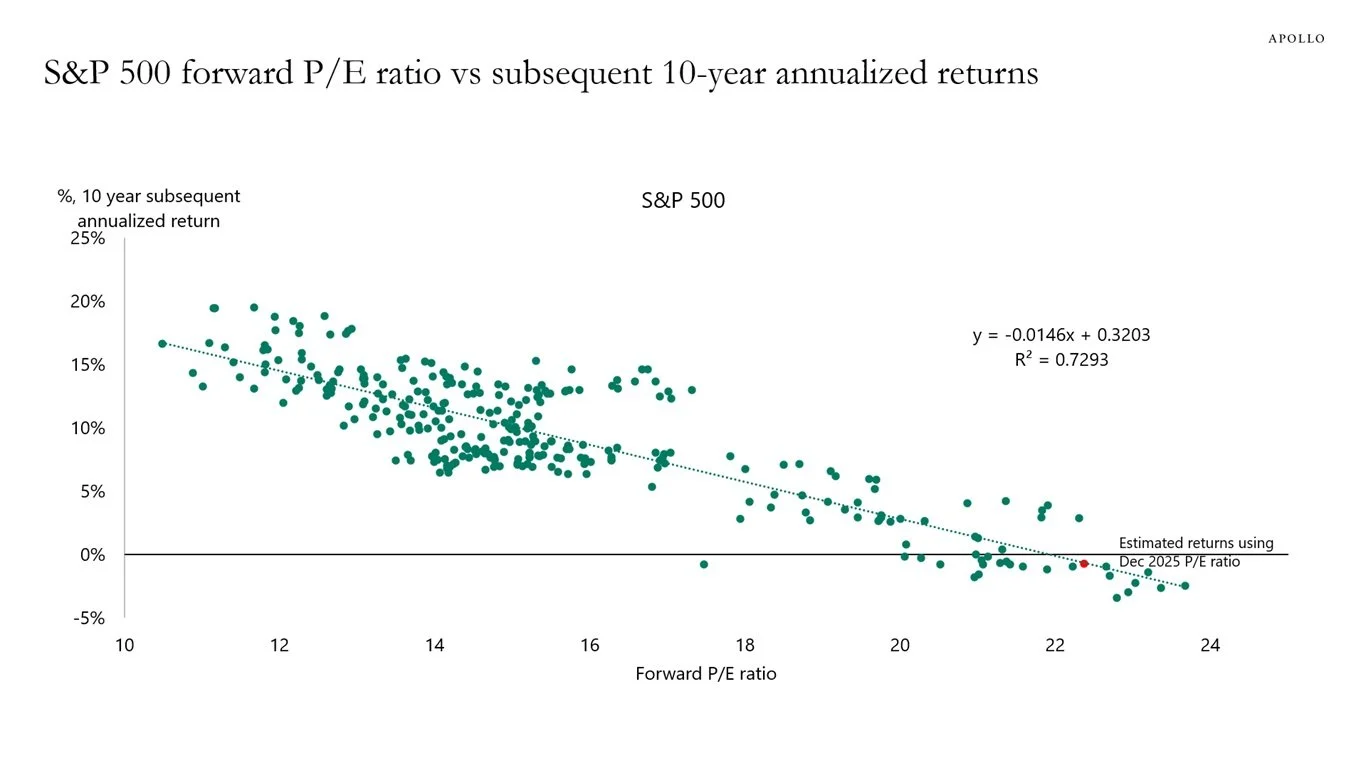
One of our favorite daily emails (from Apollo) recently pointed out that “investors should expect to get zero in return in the S&P 500 over the coming decade”. See chart below.
So if you asked the question, would you take an investment with declining diversification, increasingly concentrated, and that has an outlook from some of the biggest names in the market predicting a return somewhere between zero and 6.5%, does it still make sense to put 60% of your portfolio in this asset class?
If you’re looking for some diversification away from this, our Faes & Co Income Fund continues to provide consistent, stable, asset-backed returns - that apparently could end up beating the market over the next decade (without the volatility)!
Continued…